

MuscleTiger research notes · No. 3
Split or full body? What the meta-analyses say
Few questions in the gym start an argument faster than this one: split or full body? Almost everyone has a firm opinion, and almost nobody says it makes no difference. The research says it makes surprisingly little, as long as one thing is kept the same.
TL;DR
When weekly sets per muscle are equal, split and full-body routines give similar strength and muscle gains: 14 studies with 392 people found no significant difference. The number of weekly sets does the work, not the name of the routine. A full-body session feels more effortful and a split leaves each muscle sorer; we found no study showing either is harder to stick to, so choose by the days you have.
To see why, it helps to notice what the two routines really change. A full-body routine trains every muscle in every session, usually three times a week, so each muscle is trained three times a week. A split divides the muscles between days, for example pushing muscles on one day and pulling muscles on another, so each muscle is usually trained once or twice a week. The two routines differ in how often a muscle is trained and in how many sets it gets per session. They do not by themselves say how many sets a muscle gets in a week.
That last number, weekly sets per muscle, turns out to matter more than the format. In this note we look at what meta-analyses (studies that pool many studies) say about weekly volume, about frequency, and about split versus full body directly. We say how strong the evidence is and what is left to choose. The numbers come from published studies, listed at the bottom; where we calculate something ourselves, we say so.
1. Two numbers that describe any routine
Whatever the routine is called, it can be described by two numbers for each muscle: how many days a week it is trained, and how many hard sets it gets on those days. Their product is the weekly volume:
where is the frequency (training days per week for that muscle), is the number of sets per session for that muscle, and is the number of weekly sets. The same can be reached in very different ways. The table shows examples for 12 weekly sets per muscle.
| Routine (example) | Frequency | Sets per session | Weekly sets |
|---|---|---|---|
| Full body, 3 days a week | 3 | 4 | 12 |
| Upper / lower, 4 days a week | 2 | 6 | 12 |
| Push / pull / legs, 6 days a week | 2 | 6 | 12 |
| Classic body-part split, 5 days a week | 1 | 12 | 12 |
All four deliver the same weekly volume. The question "split or full body" is therefore really two questions: does weekly volume matter, and does it matter how it is divided between days?
2. Volume: the number that matters
Schoenfeld et al. [7] pooled 15 studies (34 treatment groups) and found a graded relationship between weekly sets and muscle growth: each additional weekly set was associated with a gain larger by about 0.37 percentage points, and the difference between higher and lower volume groups was about 3.9%. One caution from the same analysis: when sets were grouped into fewer than 5, 5 to 9 and 10 or more per muscle, the effect showed only a trend (P = 0.074), so the exact thresholds are not firmly established.
A larger analysis by Pelland et al. [8] pooled 67 studies with 2,058 participants and confirmed that both muscle size and strength increase with weekly volume, with diminishing returns that are much stronger for strength. An umbrella review of 14 meta-analyses [9] concluded that volume is the only training variable with an observed dose-response relationship for hypertrophy, and recommends at least about 10 weekly sets per muscle group.
3. Frequency: first it looked important, then it did not
In 2016 Schoenfeld et al. [3] pooled ten studies and found that training a muscle more often was associated with a larger hypertrophy effect (0.49 against 0.30). They concluded that major muscle groups should be trained at least twice a week.
Comparisons like this have a trap: a group that trains a muscle more often often also does more sets in total, so frequency and volume get mixed up. The same group of authors therefore repeated the analysis in 2019 [2] with 25 studies and separated the volume-equated trials from the rest. When volume was equal, there was no significant difference between lower and higher frequency, including for upper and lower body separately and for direct measures of muscle growth. When volume was not equal, higher frequency did show a modest advantage, which is what you would expect if the extra sets were doing the work. They concluded that there is strong evidence that frequency does not significantly or meaningfully affect hypertrophy when volume is equated, and that people can choose a weekly frequency per muscle based on preference.
A 2026 preprint, not yet peer reviewed, looked only at volume-equated trials [10]: 16 trials with 380 participants, comparing one to three sessions per muscle per week. The effect of frequency was trivial and not significant (Hedges' g = −0.06, 95% confidence interval −0.24 to 0.13). Here g is the difference between groups in units of standard deviation, so 0.06 is negligible. The authors rate the certainty of the evidence as low to very low, and note that most trials measured muscle thickness, which does not track whole-muscle growth perfectly. Pelland et al. [8] likewise found that the effect of frequency on hypertrophy was compatible with a negligible one.
4. Split versus full body, head to head
The direct comparison has been pooled in one meta-analysis: Ramos-Campo et al. [1] included 14 studies with 392 participants (196 in each arm) that compared split and full-body routines. Programmes lasted from 4 to 12 weeks, the average age was 25, and 11 of the 14 studies were in men; only three included women. Ten studies had a low risk of bias and four had some concerns. Strength was measured as the one-repetition maximum (1RM) in the bench press and in a lower-limb lift, and growth as the cross-sectional area of three muscles and as lean body mass.
Their paper reports the results in tables that are hard to read, so we redrew them. Each study gives one number: how much more the full-body group gained than the split group, in percentage points of improvement over the baseline. A square is the study's estimate and the line is its 95% confidence interval, the range of values that fit that study's data. The green diamond is the pooled result. Bigger squares are studies that count more because they are more precise. A line that crosses the orange zero line cannot tell the routines apart.
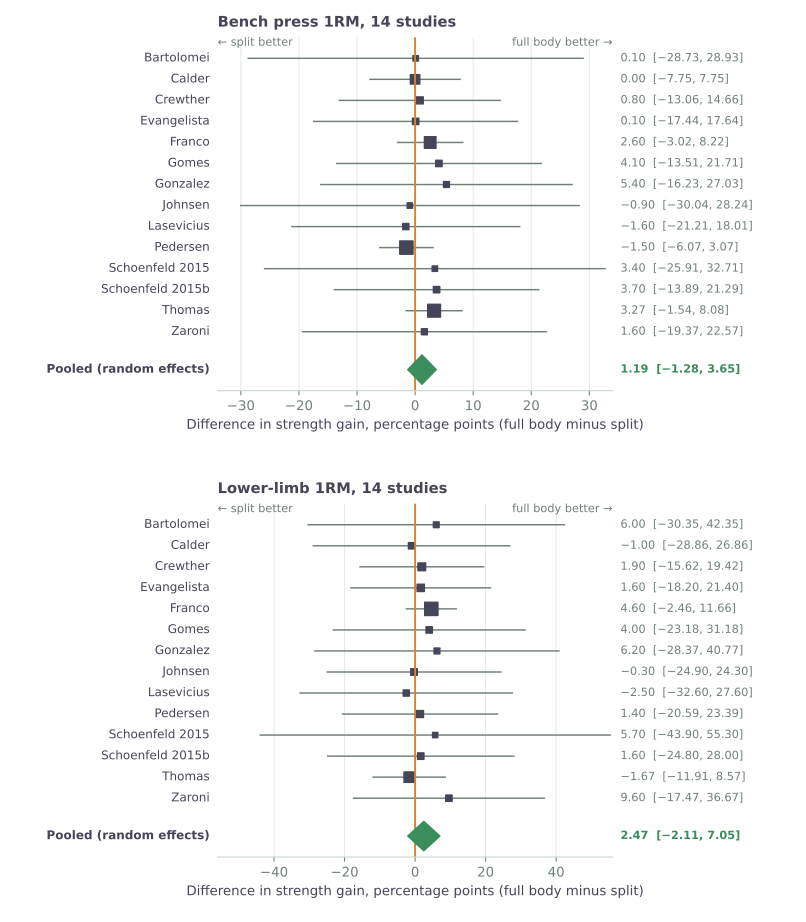
Look first at the individual lines. They are long: from −30 to +30 points in the smallest studies. That is expected. Most groups had only 9 to 15 people, and the gains of individual people differ a lot (the standard deviation of the gain is often 20 to 40%), so no single study can pin the difference down. This is also why the studies were pooled, and why a lone trial that shows one routine winning, in either direction, means little.
The picture changes when all 14 are read together. Not one study found a clear advantage for either routine, and the estimates cluster around zero from both sides: for bench press 10 of 14 sit slightly on the full-body side and 3 on the split side, for the lower limb 10 and 4. The pooled interval is much tighter than any single line. For the bench press it rules out a split advantage larger than about 1.3 points and a full-body advantage larger than about 3.7 points, on gains that averaged around 9 to 10%. So the result is not “it depends”: across 14 independent trials, with different populations and programmes, whichever routine was used, the gains came out within a few percent of each other. The slight lean towards full body is within the noise, and small differences cannot be excluded. A caveat on the heterogeneity figure: I² = 0% means the studies disagree no more than their large uncertainty allows, which is a weak test when every study is this imprecise.
The paper also pooled muscle size. To compare strength and growth on one scale, we recalculated every outcome as a standardized difference (Hedges' g), which expresses the gap in units of standard deviation. Our recalculation from the per-study data reproduces the authors' pooled values for the five raw outcomes.
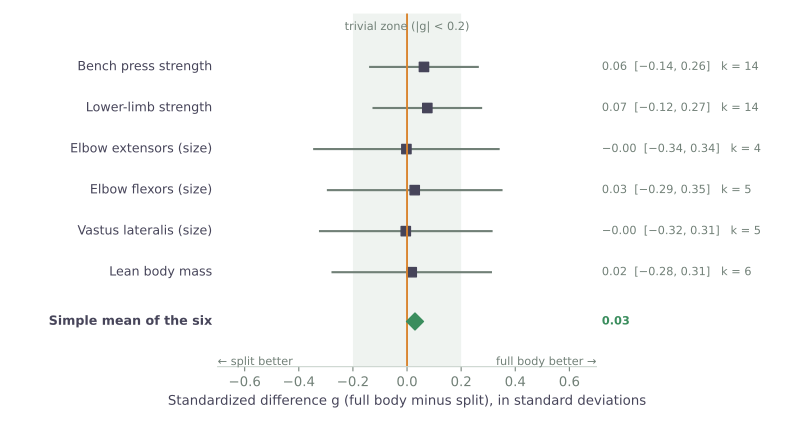
All six estimates are within about 0.08 standard deviations of zero, and all intervals include zero. The average difference is 0.03 standard deviations, which is negligible. The authors concluded that, when volume is equated, a split or a full-body routine does not significantly affect either strength or hypertrophy, and that people can choose according to preference.
The limits of this are real. Studies were short, mostly in young men, and measured muscle size with different methods (mostly ultrasound). The interval for each muscle is wider than for strength, about ±0.3 standard deviations, so small differences cannot be excluded.
Two individual trials show how small studies can look different from each other. Schoenfeld et al. [5] compared a split (each muscle once a week) with a total-body routine (three times a week) in 20 well-trained men. Forearm flexor thickness grew more with the total-body routine, with no difference in maximal strength, and the authors suggested a possible benefit of higher frequency. Saric et al. [6] compared training three times and six times a week with equal volume in 27 trained men over six weeks. Strength gains were similar (upper body +4% against +6%, lower body +22% against +18%) and so were most thickness gains, although only the three-session group significantly increased elbow flexor thickness (+7%). Results on single muscles jump around in studies of this size, which is why pooling them is useful.
5. Strength may be slightly different
For strength the picture is less clear. Grgic et al. [4] pooled 22 studies and found that strength gains rose with frequency: effect sizes of 0.74, 0.82, 0.93 and 1.08 for training 1, 2, 3 and 4 or more times a week. But in the volume-equated subgroup frequency had no significant effect (p = 0.421), so the apparent benefit seems to come mostly from the extra volume. A newer analysis [8] found that, unlike for hypertrophy, the effect of frequency on strength was identifiable, with diminishing returns. A possible reason is that lifts are skills, and practising them more often helps, but this is a hypothesis and not something these studies tested.
6. Is a full-body session harder?
A common objection runs like this: even if the results are the same, training the whole body in one session is more demanding than training one or two muscle groups. It sounds plausible, and the direct evidence is thin, so here is what exists.
The closest test of “more work in one sitting” is a crossover study by Pedersen et al. [11]. Twenty-three trained women did the same 18 sets of lower-body exercises either in one 46-minute session or in two sessions 3.5 to 5 hours apart on the same day (43 minutes in total). This is not a split against a full-body week, only a test of how a larger session feels. The long session was rated as more effortful (7 against 6 out of 10) and more uncomfortable (6 against 5). It was also rated as more pleasant on one scale, enjoyment did not differ, and readiness to train 24 hours later did not differ. Two sessions allowed about 3% more repetitions (169 against 164). When asked which they would choose for regular training, 22 of the 23 women picked the long session, mostly because it saved a second trip to the gym and because they liked the feeling of a hard workout.
The second thing people feel is soreness, and here the picture is the opposite of the objection. Carneiro et al. [12] followed 23 well-trained men for 8 weeks with the same 75 sets per week, five days a week. One group trained every muscle every day, with one or two sets per exercise. The other trained one body area per day with ten sets per exercise. Muscle soreness on a 0 to 10 scale was higher in the split group at weeks 1, 4 and 8, for all five regions measured. The paper reports the split group as roughly 3.5 to 7.5 times higher depending on the muscle and week, with those numbers taken from the same group's earlier trial [13], which we have not read in full. The same paper reports that the full-body group lost fat (−0.8 kg) while the split group gained a little (+0.3 kg), p = 0.04, which the authors link to soreness reducing daily activity. We treat that last part with caution: it is a secondary result in 23 people, the full-body group did more total work because of extra warm-up sets, and daily activity was not measured.
Put together, the evidence does not say that full body is harder. A session with more work in it feels more effortful, but the trained women liked it and recovered as well. A routine that puts many sets on one muscle in one day leaves that muscle sorer. The load is moved around rather than increased, and both studies are small, short, and in trained people only.
7. Is it harder to stick to?
This is the question people actually care about, and no study we found answers it directly. We found no trial that followed people on a split and on a full-body routine for months in ordinary life and compared who quit. What exists is indirect.
- Attendance when supervised. In the 8-week trial above [12] attendance was 98% for full body and 97% for split, so no difference. Participants were closely supervised by trainers, which makes keeping up easier than at home.
- Preference for one big session. In [11] almost everyone preferred a single long session, mainly because of time. That is a point about travel and scheduling, not about the training itself, as the authors note.
- Time as a barrier. The authors of [11] cite studies in which lack of time is among the most reported barriers to exercise. That points to a practical rule: the better routine is the one whose number of sessions and session length fit your week.
So the honest answer to a friend who says full body is harder to keep up is that it may be for some people, and easier for others. A full-body routine needs fewer weekly sessions for the same sets per muscle, but each session is longer. A split has shorter sessions, but you need more days. Which of these suits you is a matter of schedule and preference, and the trials do not show that either one costs you results.
8. What the evidence cannot tell us
- Who was studied. In the largest analysis [8] 79% of participants were men with an average age of about 25. Results for women, older people and experienced lifters are much thinner.
- For how long. Typical trials last from four weeks to a few months; the 14 in the head-to-head analysis ran 4 to 12 weeks. Nothing here says what happens over years.
- What was measured. Most trials measured muscle thickness or cross-sectional area at a few sites, not the whole muscle.
- No difference detected is not no difference. The intervals above are wide enough to hide small effects, and the 2026 preprint rates its own certainty as low to very low [10].
- Real-life adherence. The two trials in sections 6 and 7 are small and short, and one was heavily supervised. Nothing we found follows people on each routine for months at home. Injury is also not covered.
Results
| Question | What the evidence says | How solid |
|---|---|---|
| Does weekly volume matter? | Yes: more weekly sets give more growth, with diminishing returns [7], [8], [9] | Several pooled analyses |
| Does frequency matter when weekly sets are equal (growth)? | No meaningful difference detected [2], [10] | Strong, but trials are small and short |
| Split against full body directly | No significant difference in strength or growth [1] | 14 studies, 392 people |
| Does frequency matter for strength? | Apparent benefit mostly from extra volume [4]; one newer analysis finds a small effect [8] | Mixed |
| Is a full-body session harder? | A longer session feels more effortful but not less pleasant, with similar readiness next day [11]; a split gave more muscle soreness [12] | Two small trials |
| Is it harder to stick to? | No direct evidence; attendance 98% against 97% in one supervised 8-week trial [12] | Very thin |
| Who and how long? | Mostly young men, weeks to months | Limits the conclusions |
How we use this in MuscleTiger
The app does not force any format: you build your own routines, split or full body, and trainers can share programs with the people they coach. Strength progress is shown by muscle group, so you can see how each part of the body is doing whatever routine you follow.
Conclusions
- Count weekly sets per muscle, not the name of the routine. The evidence points to volume as the main driver. Around 10 weekly sets per muscle is a reasonable starting point, with diminishing returns beyond it.
- With equal sets, split and full body give similar results. Choose the one that fits the days you can train and the sessions you will actually do.
- For strength, more frequent practice may help a little, but the evidence is mixed.
- Full body is not clearly harder or easier to keep up. A bigger session feels more effortful, a split makes each muscle sorer, and the trials found no difference in attendance. Pick by the days you have.
- The argument lasts because older studies mixed frequency with volume. A routine that trains a muscle more often often also gave it more sets, and the sets did the work.
Limits of this note. It describes group averages from studies mostly on young men. Individual preferences, experience, injuries and schedules differ. This is general information, not medical advice; if you have an injury or a medical condition, talk to a doctor or a qualified coach before changing your training.
Sources
- Ramos-Campo DJ, Benito-Peinado PJ, Andreu-Caravaca L, Rojo-Tirado MA, Rubio-Arias JA. Efficacy of split versus full-body resistance training on strength and muscle growth: a systematic review with meta-analysis. J Strength Cond Res 2024;38(7):1330–40. doi:10.1519/jsc.0000000000004774
- Schoenfeld BJ, Grgic J, Krieger J. How many times per week should a muscle be trained to maximize muscle hypertrophy? A systematic review and meta-analysis of studies examining the effects of resistance training frequency. J Sports Sci 2019;37(11):1286–95. doi:10.1080/02640414.2018.1555906
- Schoenfeld BJ, Ogborn D, Krieger JW. Effects of resistance training frequency on measures of muscle hypertrophy: a systematic review and meta-analysis. Sports Med 2016;46(11):1689–97. doi:10.1007/s40279-016-0543-8
- Grgic J, Schoenfeld BJ, Davies TB, Lazinica B, Krieger JW, Pedisic Z. Effect of resistance training frequency on gains in muscular strength: a systematic review and meta-analysis. Sports Med 2018;48(5):1207–20. doi:10.1007/s40279-018-0872-x
- Schoenfeld BJ, Ratamess NA, Peterson MD, Contreras B, Tiryaki-Sonmez G, Alvar BA. Influence of resistance training frequency on muscular adaptations in well-trained men. J Strength Cond Res 2015;29(7):1821–9. doi:10.1519/jsc.0000000000000970
- Saric J, Lisica D, Orlic I, Grgic J, Krieger JW, Vuk S, Schoenfeld BJ. Resistance training frequencies of 3 and 6 times per week produce similar muscular adaptations in resistance-trained men. J Strength Cond Res 2019;33(7S):S122–9. doi:10.1519/jsc.0000000000002909
- Schoenfeld BJ, Ogborn D, Krieger JW. Dose-response relationship between weekly resistance training volume and increases in muscle mass: a systematic review and meta-analysis. J Sports Sci 2017;35(11):1073–82. doi:10.1080/02640414.2016.1210197
- Pelland JC, Remmert JF, Robinson ZP, Hinson SR, Zourdos MC. The resistance training dose response: meta-regressions exploring the effects of weekly volume and frequency on muscle hypertrophy and strength gains. Sports Med 2026;56:481–505. doi:10.1007/s40279-025-02344-w
- Bernárdez-Vázquez R, Raya-González J, Castillo D, Beato M. Resistance training variables for optimization of muscle hypertrophy: an umbrella review. Front Sports Act Living 2022;4:949021. doi:10.3389/fspor.2022.949021
- Resistance training frequency and muscle hypertrophy: a systematic review and meta-analysis of volume-equated trials. medRxiv 2026 (preprint, not peer reviewed). medrxiv.org
- Pedersen H, Saeterbakken AH, Fimland MS, Iversen VM, Schoenfeld BJ, Stien N, Andersen V. Effects of one long vs. two short resistance training sessions on training volume and affective responses in resistance-trained women. Front Psychol 2022;13:1010596. doi:10.3389/fpsyg.2022.1010596
- Carneiro MAS, Nunes PRP, Souza MVC, Assumpção CO, Orsatti FL. Full-body resistance training promotes greater fat mass loss than a split-body routine in well-trained males: a randomized trial. Eur J Sport Sci 2024;24(6):846–54. doi:10.1002/ejsc.12104
- Gomes GK, Franco CM, Nunes PRP, Orsatti FL. High-frequency resistance training is not more effective than low-frequency resistance training in increasing muscle mass and strength in well-trained men. J Strength Cond Res 2019;33(Suppl 1):S130–9. doi:10.1519/JSC.0000000000002559 (soreness data as reported in [12])